Equestrian Legends & Folklore
The Devil and the Horseshoe: The Dark Legend Behind an Ancient Good-Luck Charm
A horseshoe above the stable door is supposed to bring good luck. But an old English legend offers a far more unsettling explanation.
BarnFlow Journal ·
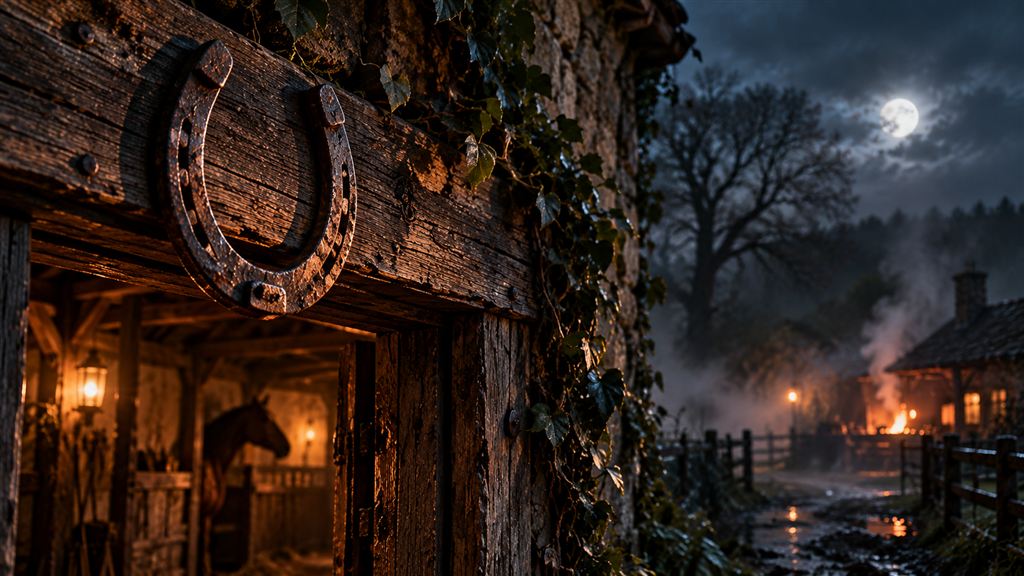
AI-generated illustration, not a photograph.
There was a knock at the blacksmith’s door.
Inside, the forge glowed red. Sparks leapt from the anvil, and the air was thick with heat. The blacksmith looked up to find a stranger standing in the doorway.
The visitor had come for a horseshoe.
There was just one problem: according to the legend, the stranger was the Devil himself.
A visitor at the forge
The blacksmith was Dunstan, a figure remembered in English folklore for his skill with iron and his ability to outwit a most unwelcome guest.
In the story, the Devil arrived demanding that his horse be shod. Dunstan recognised him, but gave nothing away. He agreed to do the work. Then, at the crucial moment, he fastened the horseshoe to the Devil’s own cloven hoof instead.
The iron bit. The Devil cried out. And the more he struggled, the more desperate he became to escape the blacksmith’s grip.
Dunstan was willing to set him free — on one condition.
The Devil must promise never again to enter a house with a horseshoe hanging above its door.
He agreed. Dunstan removed the shoe, and the Devil fled.
From that day on, so the legend says, an ordinary piece of iron could keep something decidedly extraordinary away.
From a horse’s hoof to a lucky charm
It is an irresistible story, especially if you have ever noticed an old horseshoe nailed above a stable entrance, farmhouse door or cottage threshold.
Of course, the legend is not proof of where the tradition began. Horseshoes have been associated with luck and protection in different places and periods, and iron itself has a long history in European folklore as a material believed to ward off unwanted spirits.
Even the way a horseshoe should hang is up for debate.
Some insist the open ends must face upwards, to hold good luck in. Others hang them downwards, believing that luck will spill over everyone who walks beneath. Both beliefs have survived, which rather neatly proves that folklore rarely follows a single set of rules.
The real man behind the story
Dunstan was a real tenth-century English churchman who became Archbishop of Canterbury. He was also associated with skilled metalwork. His dramatic encounter with the Devil, however, belongs to the world of legend, not established biography.
Over the centuries the tale acquired new details. In some versions Dunstan uses red-hot tongs. In others, the visitor is disguised. The horseshoe version became especially memorable because it offered an explanation for an everyday custom that people could see on their own doorsteps.
Perhaps that is why the story has lasted.
A horseshoe is such an ordinary object: a practical piece of metal made to protect a horse’s hoof. Yet place it above a door, and it becomes a promise of protection for everything inside.
Is it superstition, tradition, or simply a charming link to the past? That depends on whom you ask.
But if you happen to have a horseshoe above your stable door this Halloween, you might be tempted to leave it exactly where it is.
BarnFlow Journal | Equestrian Legends & Folklore