Horse & Welfare
A Better Farrier Visit Starts at Home
How to prepare your horse for calm, safe hoof care
BarnFlow Journal ·
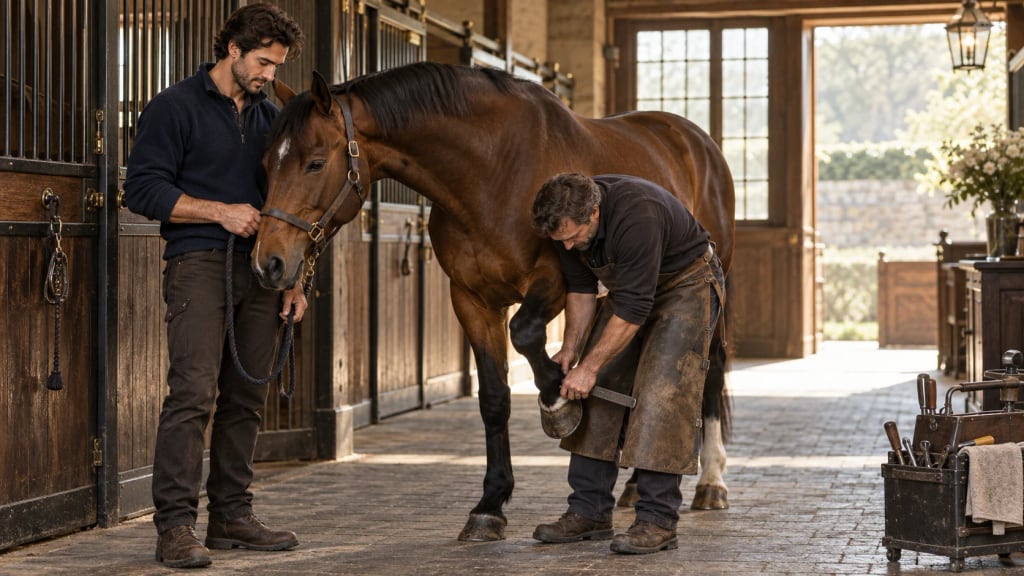
AI-generated image, not a photograph.
A horse that stands calmly and allows its feet to be handled makes life easier for the farrier. More importantly, good preparation can help make routine hoof care safer and less stressful for everyone involved.
But this does not come naturally to every horse. Some pull their legs away, constantly shift their weight or struggle to stand still for an extended period. Others become unsettled by unfamiliar equipment, noise or the feeling of having a leg held.
The solution often begins long before the farrier arrives.
With short, consistent training sessions, you can gradually help your horse become comfortable with being touched, having its feet lifted and standing quietly. The aim is not to suppress signs of tension, but to help your horse understand the process and feel more comfortable with it.
Why preparation matters
During trimming or shoeing, a horse needs to remain in a particular position while the farrier works close to its body and carefully handles its legs and feet.
If a horse suddenly pulls away, moves sideways or loses its balance, the situation can become dangerous for both horse and handler.
Preparation helps the horse become familiar with the different parts of the visit. It also allows the owner to recognise signs of tension and make adjustments before the situation escalates.
Remember that resistance is not always a training issue. Pain, sensitivity, fatigue, balance difficulties or previous negative experiences may all play a role. A horse that suddenly becomes reluctant to lift a foot should be assessed rather than simply trained more firmly.
Step 1 — Teach your horse to stand quietly
Before asking your horse to lift its feet, teach it to stand calmly beside you for short periods.
Choose a familiar, quiet area with level, non-slip footing. Use a correctly fitted halter and an experienced handler where necessary.
Ask your horse to stand still. Reward calm behaviour without allowing the session to become a constant struggle to prevent walking forward, backing up or leaning into you.
Start with a few seconds and gradually increase the duration. A short session that ends well is more useful than a long session in which tension continues to build.
Pay attention to body language. A horse that breathes normally, can lower its head and distributes its weight comfortably is generally in a better position to learn than one that becomes rigid or repeatedly tries to escape.
Step 2 — Make leg handling familiar
Move on only when your horse can remain reasonably relaxed.
Starting at the shoulder, gently run your hand down the leg. Stop before your horse becomes noticeably tense. Repeat calmly and gradually work towards the fetlock and hoof.
The objective is not to ignore every reaction. It is to introduce touch in a way that allows the horse to become comfortable without feeling threatened.
If your horse pulls away, stiffens or tries to move off, make the exercise easier. Return to an area where the horse feels comfortable and try again later.
Do not force a frightened horse to endure the exercise. Gradual habituation and positive associations require time and repetition.
Step 3 — Practise lifting the feet
Once your horse accepts leg handling calmly, begin practising the lifting of each foot.
Use an appropriate, familiar handling technique and adapt your approach to the individual horse. Keep the first attempts simple: a small shift of weight or a brief lift may be enough to begin.
Support the foot only for as long as your horse remains comfortable. If the exercise becomes difficult or the horse struggles to balance, return the foot to the ground in a controlled manner.
Gradually build towards holding the foot for a few seconds, then increase the duration as the horse becomes more confident.
Take particular care with the hind legs. Avoid standing unnecessarily behind the horse, and never try to hold a struggling leg by force. If you are unsure how to lift a horse's feet safely, ask an experienced professional to guide you.
Step 4 — Practise between farrier appointments
Do not wait until the next farrier visit to discover whether your horse is comfortable having its feet handled.
Make hoof care part of a calm, regular routine. Check the feet regularly and practise lifting them in short sessions suited to your horse's current ability.
You do not need to recreate a complete farrier appointment every time. Repeating the basic skills consistently matters more than the length of a single session.
Use rewards that suit you and your horse. Calm verbal praise, a pause or carefully taught food rewards can reinforce the behaviour you want.
Food rewards should be offered safely and should not encourage biting or pushy behaviour. Seek guidance from an experienced trainer if necessary.
Step 5 — Prepare the environment
Even a well-prepared horse may become unsettled in an unsuitable working environment.
Before the appointment, make sure that:
- The working area is level, dry, well lit and non-slip.
- The horse's legs and hooves are clean and dry.
- The horse wears a correctly fitted halter.
- There is sufficient space to work safely.
- Dogs, unnecessary activity and other distractions are kept away.
- Anyone assisting knows what is expected of them.
Bring your horse to the work area in good time rather than rushing the preparation. Tell the farrier in advance about any previous difficulties, sensitivity, fear or problems with particular feet.
The farrier needs a safe working environment and enough room to do the job properly.
Step 6 — Recognise when to stop
Repeatedly snatching a foot away, becoming rigid, sweating unexpectedly, constantly shifting weight or attempting to escape can indicate that a horse is struggling with the situation.
This does not automatically mean the horse is being disobedient.
Stop if the situation becomes unsafe. Do not attempt to force the horse to stand still through increased pressure or punishment. Professional support is appropriate when fear, aggressive reactions or repeated dangerous behaviour occur.
If behaviour changes suddenly, pain or another physical problem may be involved. Discuss the change with your veterinarian and farrier.
Some horses need additional behavioural support. In certain cases, a veterinarian may also determine that medication is necessary to allow care to be performed safely. Never administer sedatives without veterinary direction.
What if your horse is not ready?
Be honest about what your horse can currently manage. Explain any difficulties before the appointment, rather than waiting until the farrier tries to lift a foot.
Agree on a realistic approach together and discuss what support may be needed. A short training session with an experienced trainer or farrier may be the best next step. In other cases, a physical problem needs to be investigated first.
Safety matters more than completing an appointment at any cost.
Better teamwork between horse, owner and farrier
Good hoof care is a team effort. The owner understands the horse's everyday behaviour, the farrier brings specialist hoof-care knowledge, and the veterinarian can help when pain or health problems are suspected.
By practising calmly at home, preparing the working area and communicating openly, you can improve the chances of a more positive farrier visit.
Not every horse will progress at the same pace, and that is perfectly acceptable. Training should match the horse's ability, with welfare and safety remaining the priority.
A calm farrier visit is not a trick to teach in a day. It is a skill you build together, one step at a time.
BarnFlow Journal | Horse & Welfare
Disclaimer: This article provides general information and does not replace individual advice from a veterinarian, farrier or qualified equine behaviour professional. Do not attempt to manage potentially dangerous situations without appropriate experience and support.